September 2026 · Volume 3 · Issue 6
Foreword to the Sixth Issue
Aslı Davaz
We are pleased to present the sixth issue of the Journal of Women and Gender in the Archives. Before turning to the contents of this issue, we would like to highlight a project directly related to our journal’s editorial focus. The special dossier entitled ‘Archives and Memory in Women’s Historiography’, published in the August 2026 issue of Toplumsal Tarih, is the result of a collaboration between our two journals.
In the dossier, Selvi Başak Öztürk examines the journal’s editorial approach and the need for a theoretical framework in Turkish-language scholarship in her article ‘Building an Editorial Approach to Women-Centred Archival Practice: Journal of Women and Gender in the Archives’. In her article ‘Incomplete Lives: Archives and Memory in Women’s Biographies’, E. Vildan Türkan discusses the possibilities of reconstructing women’s biographies from scattered fragments. In her study ‘Mefkûre Mollova and Hayriye Memova-Süleymanova: Bringing Silenced Lives to Light from Destroyed Archives’, Nurie Muratova uncovers traces of Turkish women intellectuals in Bulgaria that have been erased from official archives, drawing on secret service records and oral history. In her article ‘Digital Traces, Losses and Feminist Archival Practice: How Should We Read Hashtags?’, Yonca Güneş Yücel examines the place of digital objects in feminist archival practice through the Hashtag Memory Collection held at the Women’s Library and Information Centre Foundation. Finally, in my article ‘Bibliographies on Women in Türkiye: The Pioneering Work of Müjgan Cunbur, Neriman Duranoğlu and Munise Aren’, I trace the history of women-centred bibliographical studies in Türkiye back to 1955.
The contributions to this dossier, which Selvi Başak Öztürk and I co-edited, demonstrate from different perspectives the importance of archives, personal testimonies, bibliographies and digital records in the production of knowledge about women’s past. We would once again like to thank Toplumsal Tarih and the authors who contributed to the dossier.
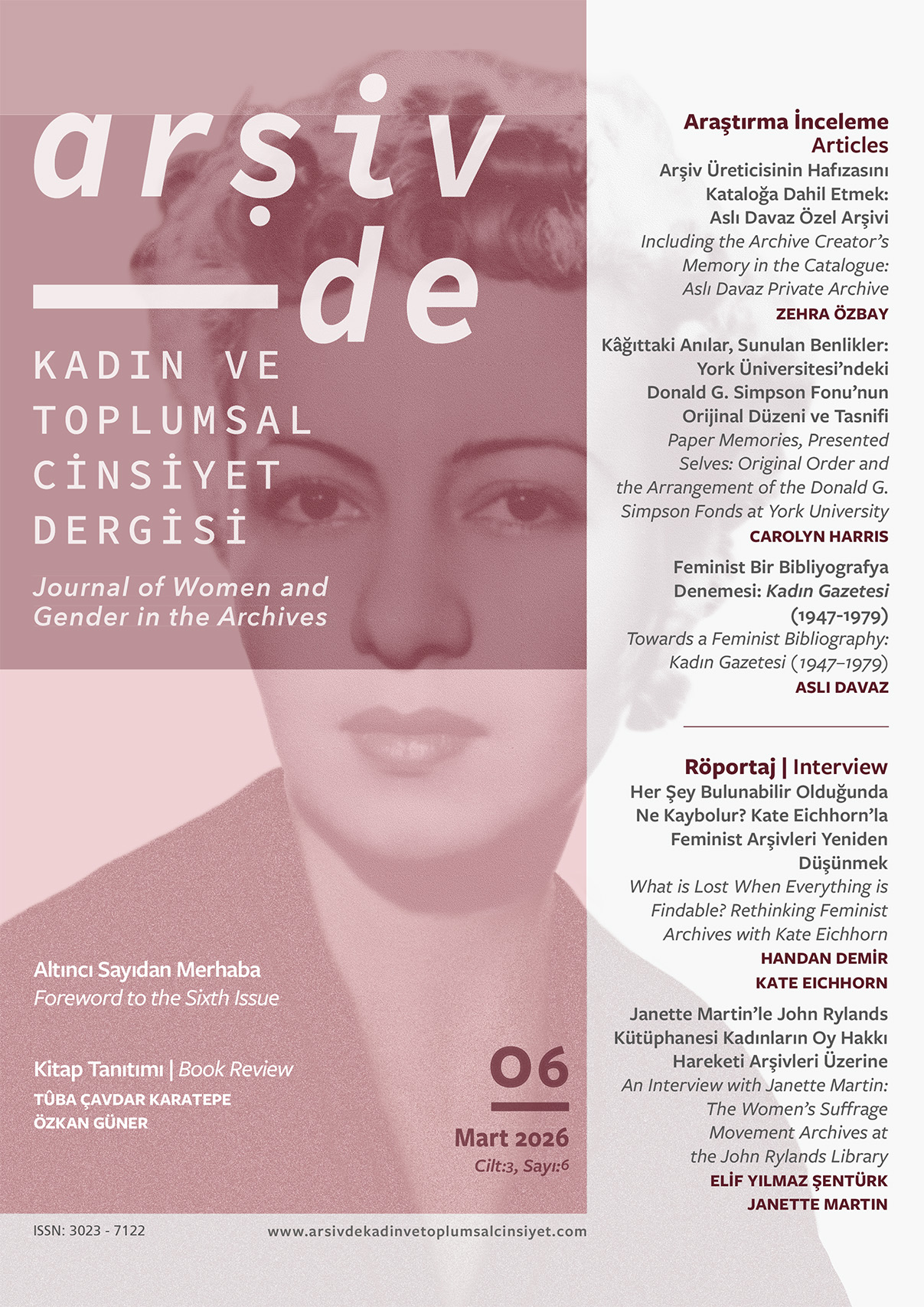
Following this dossier, what can readers expect to find in our sixth issue? The first article in the Articles section is ‘Including the Archive Creator’s Memory in the Catalogue: Aslı Davaz Private Archive’ by Zehra Özbay, an information and documentation specialist who completed her master’s degree with a thesis on privacy in private archives and currently works as a librarian at the Orient-Institut Istanbul. The article examines the work carried out on a private archive as a reflexive case study, focusing on three issues: making visible the identity and labour of the person responsible for cataloguing; the ‘Creator’s Note’ field, developed to record contextual information that only the archive creator can provide; and documenting the reasons behind decisions concerning selection, appraisal and the exclusion of records from the archive. Drawing on the role of personal archives in preserving subjective memory and, in particular, women’s historical experiences, Özbay relates Viviane Frings-Hessami’s concept of ‘recordkeeping literacy’ to the archive creator’s practice of consciously creating, arranging and preserving their own archive for the future. Different sections of the archive, comprising approximately 9,000 records, were arranged and described by six volunteers at different stages, bringing different forms of knowledge and experience into the cataloguing process. Identifying the volunteers by name in the catalogue also makes visible the archival labour that often remains anonymous.
The ‘Creator’s Note’, a distinctive feature of the study, enables contextual information based on the archive creator’s memory, which cannot be obtained from the records alone, to be recorded separately from the archivist’s description, with its source clearly identified. Özbay particularly emphasises that this information should be regarded not as objective fact, but as selective testimony that may change over time. The article also notes that privacy, personal rights and the protection of third parties were taken into consideration when determining the scope of the archive, and that certain records were excluded on these grounds. The study thus demonstrates that, in personal archives, the question of which records are excluded, and why, is as much a part of the history of the archive’s formation as the question of which records are preserved. Ultimately, the article highlights the need to document not only the records themselves, but also the labour involved in arranging and describing them, the contextual knowledge produced during the process, the decisions made and the archive creator’s contribution. It also underscores the importance of preserving pre-donation cataloguing work as an integral part of the archive’s processing history.
The second article in this section is Carolyn Harris’s ‘Paper Memories, Presented Selves: Original Order and the Arrangement of the Donald G. Simpson Fonds at York University’. In this article, Harris examines the Donald G. Simpson Fonds to explore why the concept of ‘original order’ needs to be reconsidered as the acquisition and preservation of personal archives belonging to living individuals become increasingly common. While preparing his memoirs, Simpson rearranged his records thematically in order to reassess his past, refresh his memory and make the records accessible to future researchers. The arrangement in which the records entered the archive was therefore a deliberate construction by the creator rather than an organic structure. Harris discusses the balance between preserving the evidential value of the fonds and respecting Simpson’s final arrangement of the records for his own use and their informational value. Drawing on theoretical approaches to life narratives, she emphasises that personal archives should be understood as selected and arranged structures through which their creators represent themselves. An important aspect of the article concerns the opportunities offered by working directly with a living archive creator. Simpson’s explanations fill gaps in the context of the records, enable scattered records to be linked to the appropriate projects and activities, bring to light information that the archivist could not have obtained independently, and allow researchers to access the records within a richer context. At the same time, this collaboration requires respect for the creator’s own interpretation of the records and their agency in arranging them. The Simpson case demonstrates that, in personal fonds, original order should be approached not as a fixed rule, but as a flexible framework that takes into account the transformations of the fonds, the creator’s memory and the dialogue between archivist and creator.
The final article in the Articles section is my own, entitled ‘Towards a Feminist Bibliography: Kadın Gazetesi (1947–1979)’. In preparing the Kadın Gazetesi bibliography, I aimed to develop a feminist bibliographical method that would go beyond conventional bibliography. I divided more than 132,000 data entries drawn from 1,125 issues of the newspaper into three groups and brought them together in 27 thematic indexes. I approached indexing not merely as a technical tool for facilitating access to information, but as a process that determines which individuals, institutions, forms of labour and experiences are made visible. The entries in the women-centred indexes bring together the women documented by Kadın Gazetesi throughout its publication history in the contexts of organisation, education, publishing labour, public activities and international relations, providing researchers with a field of enquiry through which women’s history can be traced. The entries in the general indexes, which also include women, enable researchers to explore women’s presence in politics, education, work, culture, consumption and everyday life within a broader social structure. The other indexes trace men’s relationships with the world of women-centred publishing and their roles in collective publishing labour, while place names make visible the newspaper’s local, national and international geographical reach. When read together, news items, photograph captions, recipes, advertisements and institutional records that might individually appear minor or insignificant make it possible to pursue broader historical questions concerning women’s organising, labour, representation, everyday life and modernisation. In this way, this experiment in feminist bibliography brings together data relating to women’s history that have been scattered across the pages of a periodical and have often remained invisible, organising them within a new structure of knowledge and providing researchers with new sources.
Following these three articles, the Interview section features two interviews. The first, entitled ‘What is Lost When Everything is Findable? Rethinking Feminist Archives with Kate Eichhorn’, was conducted by archivist, editor and poet Handan Demir with Kate Eichhorn, Professor and Chair of Culture and Media Studies at The New School. The interview opens up a discussion of the transformation of feminist archival practice over the past twenty years, within a broad framework extending from analogue cultures of production to digital platforms. Demir’s questions provide an opportunity for Eichhorn to reconsider her ideas on the ‘archival turn’ and relationships between feminist generations, while also examining the changing political, economic and technological conditions of feminist cultural production through zine culture, cataloguing, photocopying, content creation and archival labour. Eichhorn now regards the ‘archival turn’ not so much as a passing theoretical trend, but as an enduring way of thinking about the relationship between past, present and future. While emphasising that feminist archives make visible continuities and political dialogue across generations, she also considers cataloguing and archival description to be forms of activist and intellectual labour in their own right. One of the central themes of the interview is the difference between analogue and digital culture. Eichhorn observes that, within photocopying culture, activists were able to appropriate existing infrastructure for their own purposes, whereas on digital platforms this relationship has been reversed: users generate economic value for platforms through the content and data they produce. This transformation also raises questions about the material and embodied dimensions of feminist and queer cultural production, as well as the visibility of the labour behind it. Towards the end of the interview, the discussion turns to the very concepts of preservation and findability. Eichhorn questions whether preserving everything and making everything findable are necessarily desirable, reminding us that archives have never been merely secure repositories of the past, but are fragile structures that continually change within political, economic and institutional conditions. The interview thus invites us to rethink feminist archival practice not only through the question ‘What should we preserve?’, but also through the questions ‘Why, how and under what conditions should we preserve it?’
The second interview in this section, entitled ‘An Interview with Janette Martin: The Women’s Suffrage Movement Archives at the John Rylands Library’, was conducted by Assoc. Prof. Dr Elif Yılmaz Şentürk, a faculty member in the Department of Information and Records Management at Marmara University and currently a visiting scholar at the University of Manchester, with Dr Janette Martin, Head of Research at the John Rylands Library. The interview explores the scope and formation of these archives, as well as their research value and accessibility. The Library holds four archives relating to the Manchester Men’s League for Women’s Suffrage, the Parliamentary Committee for Women’s Suffrage, the National Union of Women’s Suffrage Societies (NUWSS) and the International Woman Suffrage Alliance (IWSA). These are complemented by the Manchester Guardian archives, the papers of the Ashworth Cross family, periodicals, pamphlets, photographs, ephemera and objects. Martin emphasises that these archives document not only the struggle for women’s suffrage, but also broader issues such as property and divorce rights, women’s education, health, war, peace and prisons. The IWSA archive, in particular, offers opportunities to explore the international dimensions of the movement and the effects of war on women and children. The records reveal how women established a presence in public and political life through meetings, marches, publishing activities, petitions and campaigns. The interview identifies the underrepresentation of working-class women and women from different ethnic backgrounds as a significant gap, since the collections predominantly reflect the experiences of middle-class women. Drawing on the example of Florence Lockwood’s autobiography, Martin emphasises the importance of bringing the lives of lesser-known women to light through personal narratives. Recently acquired photographs and ephemera offer new research opportunities for examining the movement’s methods of visual propaganda. Looking ahead to the centenary of the Equal Franchise Act in 2028, Janette Martin explains that she aims to prepare a subject guide on women, research the stories of lesser-known women, develop the existing digital exhibition and make as much of the suffrage archives as possible freely accessible online.
Following the interviews, the Book Review section features reviews of two publications. In the first review, entitled ‘Rereading Didar Bayır’s Grey Literature from the Perspective of Women’s Archives’, Prof. Dr Tûba Çavdar Karatepe, former Head of the Department of Information and Records Management at Marmara University, discusses the book Gri Yayınlar: Sağlama, Bibliyografik Sunuş ve İşlemler by Didar Bayır, Head of the Division of Librarianship in the Department of Information and Records Management at Istanbul Medeniyet University. The book is based on a master’s thesis completed in 1986 under the supervision of Jale Baysal and aims to serve as a handbook for librarians and information professionals working with grey literature. The study examines the definition and terminology of grey literature, the SIGLE Project and common types of grey literature, as well as procedures for acquisition, cataloguing, classification, shelving and access. Bayır defines grey literature as ‘types of documents that cannot be acquired through conventional publishing and distribution channels and that differ from traditional publications such as books and journals because of their formats, variations in bibliographic presentation and other characteristics’. Among the central issues addressed in the book are the long-standing lack of consistent terminology in Türkiye, differing views on which documents should be included in this category, and the absence of adequate bibliographic control. Karatepe emphasises that newsletters, brochures and similar publications are important sources because they reveal the histories of institutions, how institutions produced and disseminated information, and who played a role in these activities. This assessment is particularly significant in relation to often-neglected records produced by women, such as announcements, newsletters, meeting notes and ephemera. Although terminology and cataloguing standards have changed over time, problems of description and access persist. Karatepe stresses that, while concepts and terminology in librarianship may change, information carriers retain their value. She argues that the book deserves to be revisited, particularly for the insights it offers into the significance of grey literature for women’s studies.
The second review in this section, entitled ‘Recording the Invisible, Tracing the Forgotten… The Discursive Construction of Memory, Transience, and Ephemera’, is written by Dr Özkan Güner, an information and documentation specialist and lecturer at Muğla Sıtkı Koçman University. In his review, Güner introduces Tanımlan(a)mayan Belgeler: Efemera by Dr Seher İnceoğlu Güner, also an information and documentation specialist. Seher İnceoğlu Güner approaches ephemera as documents and objects produced to fulfil a particular function for a limited period and considered likely to lose their value once their period of use has ended. In her book, she examines the concept of ephemera from historical, theoretical and practical perspectives, focusing on its definition, types and the challenges it presents for archival practice and information and records management. She notes that the absence of a commonly accepted definition of ephemera across different professional fields and within archival practice makes it difficult to describe these materials and, consequently, to provide access to them. The author regards ephemera not as a single document type, but as an ‘umbrella concept’ encompassing multiple document types and as a metadata field. She explains that ephemeral materials are held by national archives, libraries, museums, non-governmental organisations, collectors, antiquarian booksellers and individuals. During the processes of collecting and building collections, these materials may become detached from their original contexts and lose their provenance, creating problems for cataloguing and classification. In his review, Özkan Güner draws particular attention to the book’s examination of these interconnected problems of description, classification, access and preservation. While emphasising the role of collectors and antiquarian booksellers in preserving these materials, Seher İnceoğlu Güner argues that researchers’ access to them should be expanded. She maintains that ephemera constitutes a form of cultural evidence, preserving the history, cultural heritage and memory of its time and providing information about individuals’ lives. The author also considers the role of the professional archivist in making these materials visible. In her conclusion, she recommends resolving the problem of defining ephemera, identifying its different types, developing a controlled vocabulary and incorporating ephemera into the acquisition policies of archival and other documentary institutions.
We hope you enjoy reading this issue and look forward to your contributions and suggestions for future issues.